 About
About Courses
 Free Course
 Contact
Best Web Development Course in Dehradun: Skills, Career Scope & Opportunities in 2026
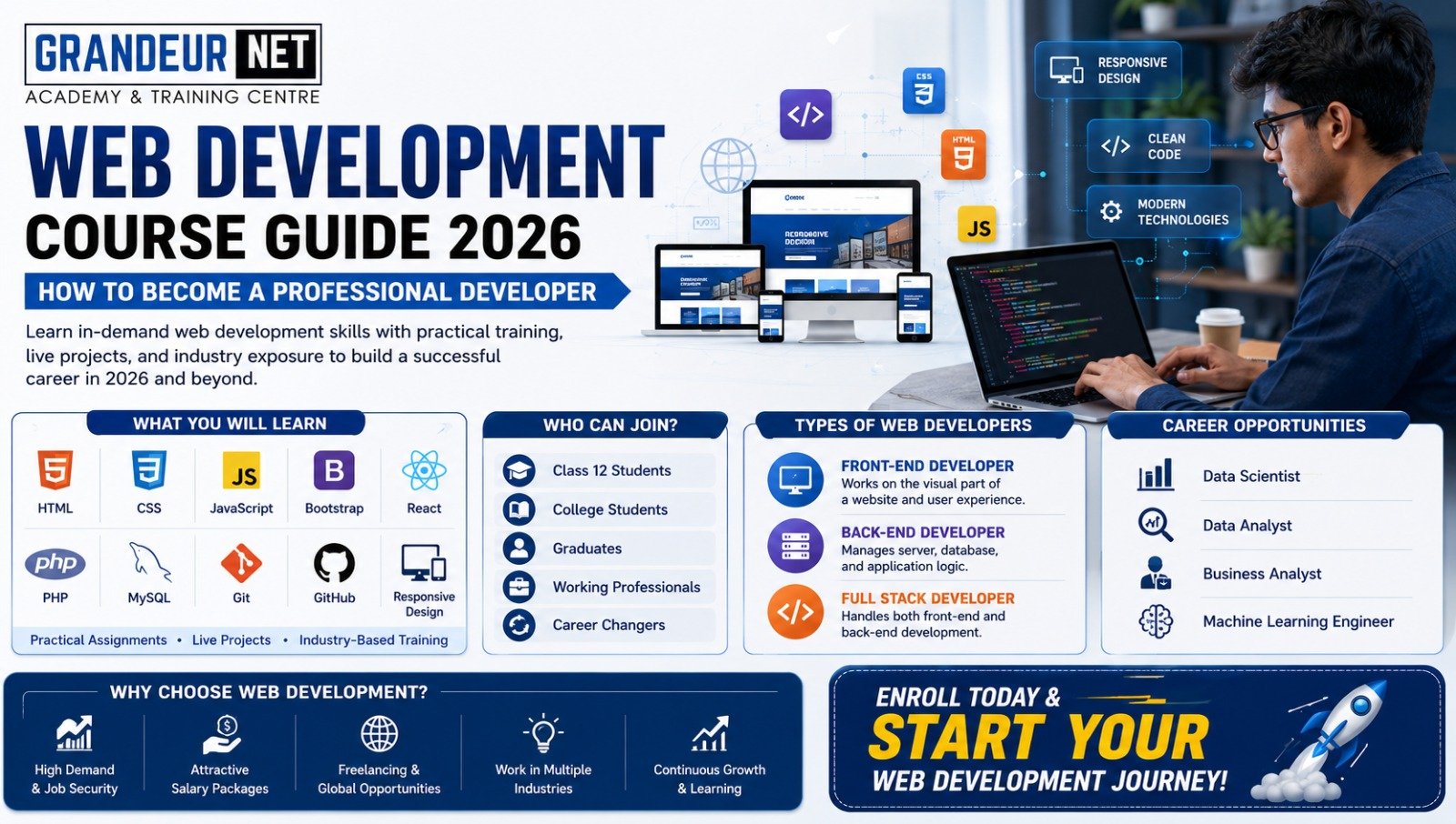





Every business today needs a website — from a small local shop to a large enterprise. But building one that's fast, secure, and genuinely easy to use takes real skill, and that's exactly where web development comes in.
As technology keeps evolving, the demand for skilled web developers keeps climbing with it. It's become one of the strongest career paths in 2026 for students and working professionals alike. Web developers build everything from business websites and e-commerce platforms to educational portals and healthcare systems — and with the right training, almost anyone can break into this field.
If you are searching for Digital Marketing & IT Training Institutes in Dehradun, choose one that offers practical learning, live projects, experienced trainers, and real placement support. Practical exposure is what actually teaches you how the industry works — not just theory in a classroom.
Web development is the process of building and maintaining websites and web applications. It covers designing pages, writing functional code, managing databases, optimizing site speed, and making sure everything runs smoothly across devices and browsers. A developer doesn't just make something look good — they make sure it actually works the way it's supposed to, every single time someone visits.
This field sits at the intersection of design and logic. You're constantly balancing how something looks with how it performs, which is part of what makes it such an interesting skill to build.
At its core, a good developer makes sure users can access information without friction. A slow, broken, or confusing website costs a business real customers — which is exactly why this skill has become so valuable across every industry, not just tech. A well-built website builds trust the moment someone lands on it, while a poorly built one drives them away just as fast.
Web development remains one of the fastest-growing career fields anywhere. Companies are investing heavily in digital transformation, and every business — regardless of size — needs a strong, functional online presence. That single fact alone creates thousands of new job openings every year, and the trend shows no signs of slowing down.
What makes this field especially appealing is how portable the skill is. A developer trained in Dehradun can work for a company in another state, another country, or run their own independent client base — the skill itself travels with you.
A career in this field offers long-term stability, constant opportunities to learn, and the chance to work with companies located anywhere in the world. Many developers also choose freelancing, taking on international clients and setting their own pace and income. Over time, this often becomes less about finding a job and more about choosing which opportunities are worth taking.
Becoming a successful web developer takes more than technical know-how alone — problem-solving and communication matter just as much once you're working on real projects with real teams. Employers aren't just hiring someone who can write code; they're hiring someone who can think through a problem and explain their solution clearly.
You'll need a solid foundation in HTML, CSS, and JavaScript. Modern frameworks like React take things further, letting you build interactive, dynamic interfaces instead of static pages. Understanding databases, version control (Git), and responsive design also makes you significantly more valuable to employers, since most real projects require all of these working together.
Beyond code, employers expect developers who communicate clearly, collaborate well within teams, and can manage their own workload without constant hand-holding. These are often the deciding factor between two equally skilled candidates, especially at the entry level where technical skills tend to look similar on paper.
Not every developer does the same job. Depending on your interest, you can specialize in one of three broad directions, and many developers eventually find they naturally lean toward one more than the others.
A front-end developer works on the part of the website users actually see and interact with. This includes building layouts, improving overall user experience, and making sure everything looks and functions correctly across mobile and desktop devices. It's a role that blends technical skill with a genuine eye for design.
Back-end developers manage the server, database, and application logic behind the scenes. Their job is to make sure the website runs securely, efficiently, and reliably — even when it isn't visible to the end user. This is where the real "engine" of a website lives.
A full stack developer can handle both front-end and back-end work. Companies value full stack developers highly because they can manage an entire project independently, without needing a large, specialized team behind them — which makes them especially valuable at startups and smaller companies.
A Web Development course in Dehradun should give you hands-on exposure to real, industry-used tools rather than outdated or purely academic material. The goal isn't just knowing what these tools are — it's being comfortable enough to use them on an actual project from day one of a job.
Learning the right combination of tools early on saves you months of relearning later. Employers today expect developers to be comfortable across the full modern stack, not just one isolated piece of it — which is why a well-structured course matters more than randomly picking up tutorials online.
Reading books and watching tutorials only takes you so far. Real growth happens when you're actually building — planning, developing, testing, and launching a website the way it happens in a real company. Theory tells you what a function does; a live project teaches you why it matters and what happens when it breaks.
This kind of hands-on work sharpens your coding instincts and teaches you to solve genuine business problems instead of textbook exercises. It's also exactly why employers tend to favor candidates with practical project experience — they can start contributing from day one instead of needing months to get up to speed.
Once you've learned web development, multiple career paths open up depending on your interests and strengths. It's rare to find a field where the same core skill set can lead to so many genuinely different day-to-day work styles.
Once you've learned web development, several career paths open up depending on your interests:
Web developers also have the freedom to freelance, launch their own agency, or build personal products on the side. This flexibility is part of what makes the field so attractive right now, especially for people who value independence over a traditional 9-to-5 structure.
The demand for web developers has spread far beyond software companies. Almost every sector now runs at least part of its operations through a website or web application, which means the hiring isn't limited to "tech jobs" in the traditional sense anymore.
Web development offers genuinely attractive salary packages for those with the right skill set. Freshers with solid technical knowledge and hands-on project experience can land strong entry-level roles, and as they gain experience and pick up advanced technologies, they move into senior positions with better pay and greater responsibility.
Freelancers and remote developers often have it even better — they can take on global clients and scale their income by handling multiple projects at once, without being tied to a single employer's pay scale.
The institute you choose plays a far bigger role in your career outcome than most people expect. Two people can learn the "same" technologies, yet end up with very different job prospects purely based on how practical and current their training actually was.
Before enrolling anywhere, check whether the course includes live projects, interview preparation, resume building, and proper certification. These details are what actually improve your employability once you start job hunting.
Becoming a strong developer takes patience and a habit of continuous learning, since the technology itself keeps shifting under your feet. The developers who stay relevant aren't necessarily the most talented — they're usually the most consistent.
The road ahead for web development looks strong. Businesses continue investing in websites, web apps, and digital platforms, and emerging technologies are opening up entirely new categories of work within the field itself — meaning the skill set you build today will keep evolving alongside the industry, not become obsolete.
Web development remains one of the best career choices for anyone drawn to technology and building things that people actually use. It offers strong job opportunities, real career growth, and the freedom to work across industries or go fully independent as a freelancer.
The right training, paired with consistent practice, is what turns genuine interest into a real career. Focus on building real projects, sharpening your coding skills, and staying current with the tools employers actually use. If you're ready to start, enroll in Web Development course in Dehradun and build the practical skills, industry knowledge, and confidence you need to succeed in today's job market.
Yes — it offers strong demand, competitive salaries, and long-term stability across almost every industry.
No. Most courses start from the basics — HTML and CSS — before moving into more advanced topics like JavaScript and React.
It depends on your interest. Full stack developers tend to be the most versatile and in-demand, since they can manage entire projects independently.
With consistent practice and a practical, project-based course, most students become job-ready within a few months.
Yes — freelancing is common in this field, and many developers build strong, sustainable incomes working with clients around the world.

.jpg)